The North doesn't need another strategy. It needs infrastructure.
26 June 2026
Every few months, another report lands with a familiar message. The North needs more investment. More skills. Better transport. Greater devolution. A stronger voice.
They're all valid.
But they all assume we know how to connect the people and organisations that already exist.
We don't.
Spend time in the Northern technology economy and you'll find world-class universities, ambitious founders, growing scale-ups, active investors and global employers. You'll also find thousands of people working hard to support them through events, incubators, accelerators and local networks.
What's missing isn't activity.
It's connectivity.
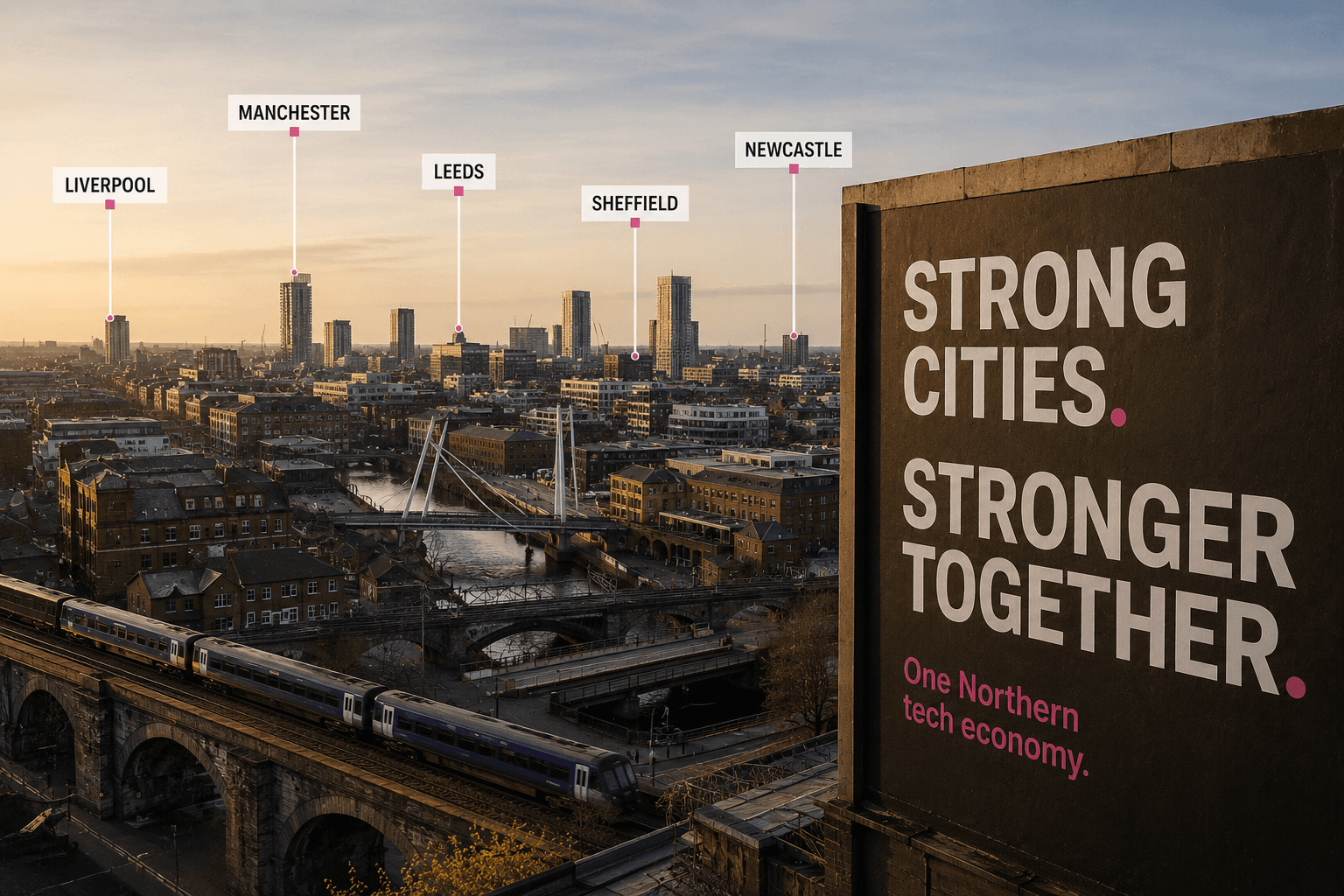
The North still behaves like a collection of successful cities rather than a single economic region. Manchester has its own conversations. Leeds has theirs. Newcastle, Sheffield, Liverpool, Hull and York do the same. That's understandable. It's also a missed opportunity.
From the perspective of a founder in California or an investor in Singapore, the choice isn't between Leeds and Manchester. It's between the North of England and Berlin. Stockholm. Amsterdam. Boston.
The competition is global.
As Andy Burnham continues to make the case for greater powers and a stronger Northern identity, there's another conversation worth having.
What does modern infrastructure actually look like?
It's easy to think of roads, railways and office space. They're essential.
But so is the infrastructure that helps people discover each other.
Today it's surprisingly difficult to answer simple questions. Which companies are scaling? Who's investing? Where are the specialist communities? Which university is leading research in a particular field? Which events are genuinely worth travelling for?
The answers exist.
They're just spread across hundreds of websites, mailing lists, LinkedIn posts and WhatsApp groups.
That creates friction.
Founders miss opportunities. Investors overlook businesses. Employers struggle to find talent that may be only a few miles away. Universities produce exceptional research that never reaches the companies that could commercialise it.
The North doesn't have a shortage of assets.
It has a shortage of visibility.
If we're serious about building one of Europe's leading technology economies, then infrastructure has to mean more than concrete and steel.
It should also mean making the Northern technology economy easier to navigate, easier to understand and easier to join.
Because the easier it is for people to find each other, the more likely they are to build something together.
That feels like infrastructure worth investing in.
)-3-768x432.jpg&w=2048&q=75)