An interview with Silicon North founder, Geoff Shepherd
24 August 2026
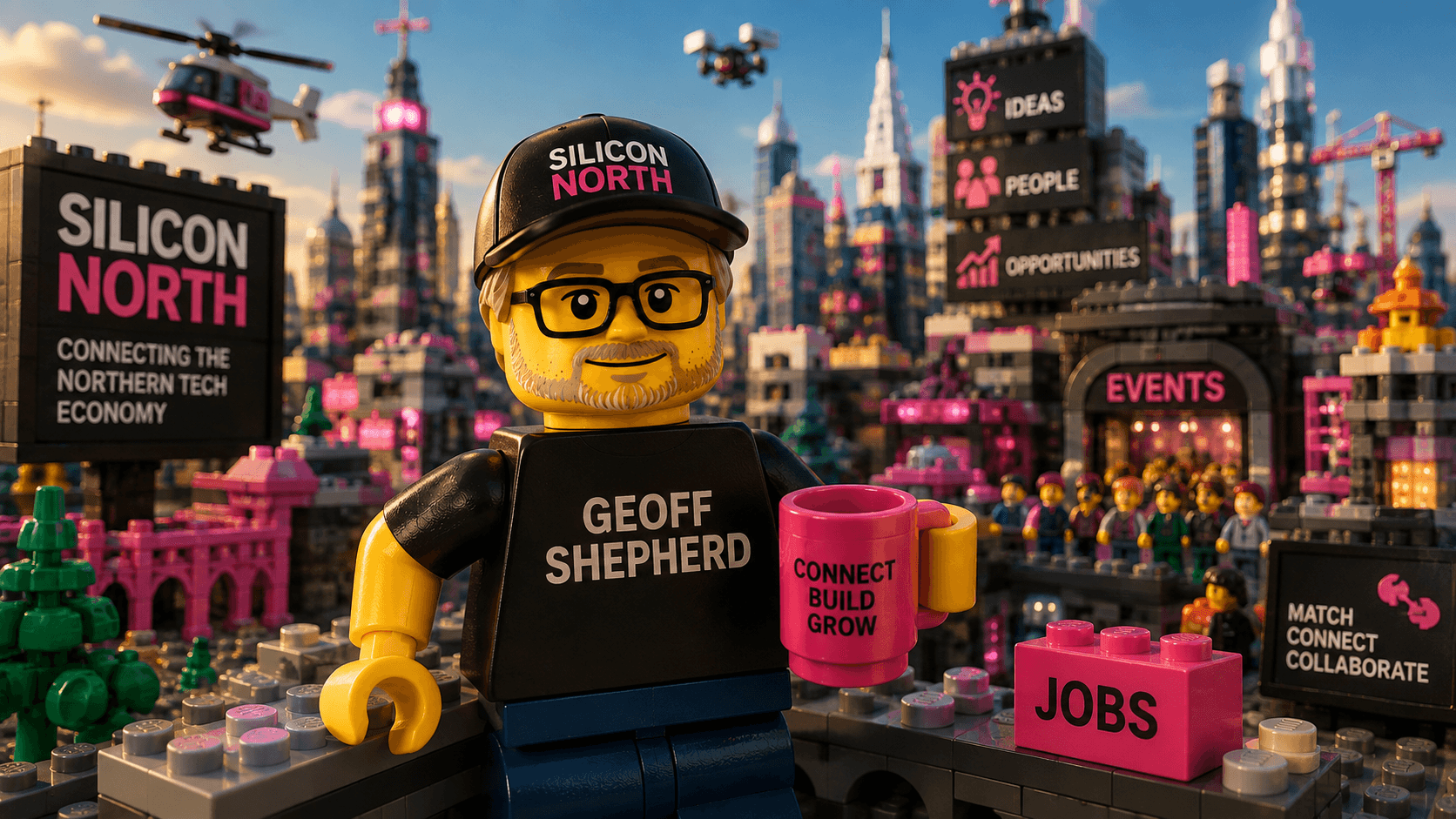
Silicon North is being built around a deceptively simple idea: the Northern technology economy already exists, but it is remarkably difficult to see as a whole. There's no front door. Its companies, founders, investors, universities, events, jobs, ideas and opportunities are spread across tens of thousands of organisations, platforms, programmes, dozens of geographic boundaries and millions of people.
Silicon North founder Geoff Shepherd believes the problem was never a lack of talent or ambition. But friction and fragmentation.
We sat down with Geoff to talk about what nearly two decades of building business communities taught him, why even successful events leave so much opportunity behind, and the ambition to create permanent, system-wide infrastructure for the Northern technology economy.
Where did the idea for Silicon North come from?
It goes back much further than Silicon North. I started The Yorkshire Mafia in 2008 and could see many of these problems then, including some we never managed to solve.
We became very good at bringing people together. We pioneered the large regional business conference model, not just at UK level but internationally. Leeds went from 700-800 attendees to almost 5000, overnight. Others have since pushed that further. We didn't create an event that was big for Leeds. We created a large world-class event that just happened to be in Leeds. That's an important distinction. Then we pioneered the multi-day digital festival and business-week/festival model that you now see in cities all over the world.
So this isn't a criticism of events. I know they work because I've spent a significant part of my working life creating them. People meet, relationships form and business gets done. But eventually I became increasingly interested in what they couldn't do... and why.
There was no glue. No continuance. You could spend months building a remarkable concentration of people, companies, ideas and opportunities, put thousands of them together and then, at the end, somebody turned the stage lights off and the whole thing was considered over.
What happens on day three of a two-day event? What happens on day 120? Why can't the content, connections and value continue to exist beyond their physical form? Why should turning the lights out end everything?
There was no permanent front door to what we'd created. I didn't want to trap the event in amber. I wanted it to never stop, to evolve, to be be dynamic and permanent.
But presumably many of the relationships created at those events did continue?
Absolutely, and that's one of the many reasons why good events are so valuable. And we should all support them.
But they rely far more heavily on chance than we tend to acknowledge.
Who knew the event was happening? Who registered? Who was free that day? Who could travel? Who intended to attend but had to cancel? Who happened to be standing next to the right person? Who was in another room when the person they really needed to meet walked past?
Our flagship event attracted around 4,500 people. It was five times larger than anything else of its kind in the region. By any normal event metric, that's a considerable success.
But Yorkshire has around 5.5 million people, and that bothered me. People would congratulate me on the attendance, but I often just saw the people who weren't there. Obviously I didn't expect 5.5 million people to turn up, but it made me question the measure of success. What about everybody else? How do we find them? How do they discover us? And then, more importantly, how does anyone in business discover anyone else? Google???
Even within those 4,500 people there was a discovery problem. You can't meaningfully discover another 4,499 people during an event. So while an event creates an extraordinary concentration of opportunity, access to that opportunity remains remarkably contingent and chance-driven.
For thousands of years we've created markets by bringing people together. From farmers' markets to general trade shows to people buying groceries.
Silicon North asks what happens when the market no longer has to close - when everyone is there, all the time, and the most relevant commercial signals are routed directly to them - automatically, on time.
So Silicon North isn't an attempt to replace physical events?
Not remotely. I love events. Time in the room matters and human relationships matter.
What I'm questioning is why we continue to treat the physical event as the entire market rather than one manifestation of it.
If somebody couldn't get to Leeds on Tuesday, why should they disappear from the opportunity? If they attended last year but not this year, why are they suddenly outside the market? Why should a founder in Carlisle need to travel to an event in Leeds on a particular date in the hope of accidentally meeting an investor (who just happens to be from the Midlands)? That's 1976. It's not at all 2026.
The event should be able to endure beyond its physical form. The people, companies, conversations, content and opportunities should remain discoverable before it, during it and afterwards. The physical gathering then becomes a very important moment within a permanent system rather than something that appears for two days and disappears again.
We don't need more big events simply because we can create them either. Climb UK in Leeds is a good example. It's a wonderful event. I'd rather help it become ten times more valuable than create ten competing versions of it. We do not need them. We need what exists to connect better.
You've described fragmentation as one of the problems Silicon North is trying to address. What do you mean by that?
Businesses don't experience the economy in the way public authority institutions often organise it.
Business works across sectors and geographies completely. Their staff live in different places. Their suppliers might be elsewhere in the country. Their customers don't stop at a funded Combined Authority boundary. Their ideas, markets, investment and talent certainly don't.
Yet a lot of economic-development activity is necessarily organised around administrative geographies. You can end up with postcode-bounded initiatives, separate platforms and more events, all attempting to solve micro versions of the same problem.
Some Combined Authorities have seen what we're building and publicly recognised that fragmentation is a problem, yet the response can sometimes be more fragmentation. That's quite a curious and telling response. I expect many of these initiatives will try to connect with each other, because eventually the needs of the user force you in that direction.
The user doesn't care which boundary they're crossing. They care about finding the right person, company, opportunity, employee, supplier, investor or customer.
Silicon North starts with the user, not which Combined Authority is footing the bill.
What were the questions that led you towards the current model?
There were three questions we found particularly difficult to answer.
The first was the founder's journey. Why should a founder in Carlisle have to travel to Leeds on a specific day to attend an event and hope they happen to meet an investor from the Midlands? That's a fundamental discovery problem. Failure of visibility. Failure of discoverability. Failure of connectivity. Platforming visibility is the first step towards solving it. Put everyone in the same place.
The second was - why do we continually respond to fragmentation by creating more things? More regional platforms, more isolated initiatives, more events. I'm not arguing against any of those things individually; many are excellent. The problem is that a collection of excellent but disconnected things is still a bunch of disconnected things.
The third question was more commercial: Why don't we already know our future customers?
It's 2026. Businesses have access to extraordinary technology and more data than at any point in history, yet we're still sending countless campaign sequences into people's inboxes, often with bad approaches that are greeted with understandable dismay.
There shouldn't be this much friction. It shouldn't be this hard.
Surely Google and LinkedIn already make businesses discoverable?
They make information searchable, which isn't quite the same thing.
Search works brilliantly when you know what you're looking for. The more interesting problem is discovering what you don't know exists.
The Northern technology economy is currently represented across a zillion websites with relatively few direct routes between them. There are company sites, event sites, universities, accelerators, public-sector programmes, directories, communities and LinkedIn pages. Each contains part of the picture, but there isn't a front door to the whole thing.
LinkedIn has around a billion people - many of whom may or may not be active. It's enormously useful, but it's clunky for what we're describing. Silicon North isn't interested in six degrees of separation. We're interested in removing friction, not cluttering inboxes with InMail campaigns for money.
And relationships alone aren't enough. What becomes really powerful is relevance combined with familiarity. Publish a white paper on LinkedIn and you might get 10 likes if you're lucky. Not cool.
How does familiarity fit into this?
Think about how business actually happens. A cold approach from a company you've never heard of is very easy to ignore, even when that company might genuinely be relevant to you.
The situation is different when you've encountered them before. Perhaps you've read something they've written, seen their company on Silicon North, noticed them at an event or come across their people several times. They become familiar.
Silicon North can't manufacture a meaningful relationship between two people, and I wouldn't want it to. What it can do is create better conditions for that commercially relevant relationship to begin.
The journey we're interested in is discoverability, visibility, relevance, familiarity, relationship and ultimately opportunity.
That's much more interesting to me than generating another database of leads.
You've called Silicon North “connective infrastructure”. What does that actually mean?
The Northern technology economy already exists. The failure is that it isn't represented as a system. There's no coherent entry point.
This is why we're building the system-wide infrastructure to support it.
Initially that means making the things within that economy easier to discover: companies, people, jobs, events, investors, universities, accelerators, opportunities, content and the organisations supporting it.
Everything relevant to technology and digital across the whole of the North of England. Big and small, new and old, those based here and those outside who want to engage with what is happening here.
The first job is visibility. Give the Northern technology economy a permanent front door.
But Silicon North doesn't need to own everything behind that door. Quite the opposite.
If NatWest or Barclays has built a great Accelerator, we don't need to build another accelerator. We can give its founders and alumni a bigger front door into the wider Northern technology economy.
If somebody has built a brilliant event, we don't need to create a competing event. We can help more people discover it and make the value around it persist. The same applies to universities, investors, communities and other ecosystem organisations.
We're not trying to replace the ecosystem. We're trying to connect it.
And who is the intended user?
I'd turn the question around. Who in the Northern technology economy couldn't benefit from this?
A student can use it to discover businesses they might want to work for. Hiring managers can find talent and understand where expertise sits. Suppliers can become discoverable to future customers and buyers can find suppliers they didn't know existed. Universities can connect research, spin-outs and talent with industry.
For a startup raising money, it's a route towards funding. For an investor, it's origination. Combined Authorities can use it to discover, weigh and eventually better understand what's happening in their own back yard. Inward-investment agencies can use it to present the actual depth of the Northern technology economy to somebody considering investing here.
Those groups are often treated as separate audiences. They aren't.
They're participants in the same system, each looking for different data, signals, information and connections within it.
The platform can make those things visible right now. What's the longer-term ambition?
There's a Phase 2. Given the amount of cloning of what we're already doing I'll keep that under wraps for now.
But ultimately the question we ask isn't “who do you know?” It's “who should you know?”
Why focus specifically on the North?
Because I live here. My children are here. My business is here. Many of my friends, and their businesses, are here. I'm here.
But I also think we've spent too long talking as though the North needs to become something else.
It doesn't.
We compare it to London.
We shouldn't.
And we certainly don't need to become more Northern.
We need to present what we already have, properly. And connect it to itself and connect it to the outside world.
The talent is here. The universities are here. The businesses are here. The ideas and ambition are here.
And ultimately, an entity that doesn't know itself, cannot discover itself and cannot be discovered by those outside it - can never become much more than it already is.
That is the bigger problem Silicon North is trying to address.
So what would success look like?
That definition moves as we move. There's always room for one more founder, one more business, one more student, one more investor, one more university, one more corporate, one more ecosystem partner. And every addition creates the possibility of something else happening.
That's where this becomes exciting, because if we get it right we're in the territory of unknown positive consequences. We can build infrastructure that improves discovery and reduces friction, but we can't possibly know every relationship or opportunity that will emerge from it.
Nor should we.
The point of a functioning market isn't that somebody at the centre decides everything that should happen. It's that the conditions exist for participants to discover value themselves.
What do you want somebody to do after reading this?
Congratulate themself on getting this far down!
Talk to us. Join us. Support what we're building and, where appropriate, pay to support it.
That isn't an appeal to charity or to regional sentiment. It's an investment in themselves and each other. An investment in me, in you and in the North. I'm basically Andy Burnham at this point 😂
People will participate for their own reasons, as they should. A company wants customers. An investor wants origination. A founder wants funding. A university wants stronger relationships with industry. A student wants a career. Those interests don't conflict with building something collectively useful; they're precisely what makes it useful.
It does require a pioneering mindset - one that our early adopters have in spades.
Too many people wait for somebody else to prove something before they're willing to participate. We've heard plenty of that from those more cautious.
But the North has been waiting for a thousand years.
And maybe, just maybe, there are enough people here who think as we do: there shouldn't be this much friction, and it shouldn't be this hard.